



2027 will be a (leap) year
The new feed-in tariff is changing the rules of the game for solar power. Those who take self-consumption, battery storage and hybrid inverters into account at an early stage will be able to continue to use solar power cost-effectively in the future.

Starting in 2027, the compensation for solar power fed into the grid will depend more heavily on the time of feed-in. The solution is already available today: battery storage systems and hybrid inverters make solar energy flexible to use, increase self-consumption, and reduce dependence on fluctuating market prices.
What Will Change Starting in 2027
If the producer and the distribution system operator cannot agree on a remuneration, the statutory default remuneration will be based on the day-ahead price at the time of feed-in, effective January 1, 2027. The quarterly PV reference market price will thus be replaced by a time-dependent market price. This price will be set the day before for each hour and is expected to be reported on a quarter-hourly basis starting in the winter of 2026.
The rule applies to systems subject to the purchase and remuneration obligation under Article 15 of the Energy Act: up to 3 MW of capacity or up to 5,000 MWh of annual production after deducting self-consumption. Excluded are facilities in the feed-in tariff system as well as facilities with a sliding market premium. Grid operators may continue to offer alternative models, such as a fixed remuneration set annually.

Example of a dynamic feed-in tariff for solar power. In the future, the tariff will be based more heavily on the time of feed-in. Source: Swissolar.
What does this mean, specifically, for operators of solar power systems?
The changes to the feed-in tariff do not mean that photovoltaics are becoming less attractive. On the contrary: Solar power from your own roof remains valuable. At the same time, it is becoming more important to use as much of the energy you generate yourself as possible right where it’s produced.
- Self-consumption is becoming more important: Every kilowatt-hour used on-site reduces the amount of electricity drawn from the grid.
- Storage systems are becoming more economically attractive: Excess solar power can be stored and used later.
- Electricity from one’s own roof is gaining value: The focus is shifting from feeding electricity into the grid to using it for one’s own needs.
- Solar power should be used on-site whenever possible: Battery storage systems, heat pumps, charging stations, and other appliances help increase self-consumption.
Store Instead of Throttling
Especially around lunchtime, high solar power generation can coincide with low demand. If day-ahead prices fall below zero, feeding power into the grid can become a cost center.
The solution is not to let valuable solar energy go to waste: A battery storage system absorbs the surplus and makes it available later for self-consumption. The hybrid inverter ensures that the energy flows where it is most useful—into the battery, to consumers in the building, or, when prices are favorable, into the grid. Only when the storage system and flexible consumers can no longer absorb any more energy is grid injection specifically limited.
Battery Storage: Using Solar Power When It's Needed
A battery storage system decouples solar production from the time of consumption. This means that excess energy generated at noon is available in the evening or early morning. This increases self-consumption, reduces electricity drawn from the grid, and makes the system less dependent on fluctuating feed-in tariffs.
- More self-consumption: Solar power is stored and used in the building at a later time.
- Fewer unfavorable feed-in conditions: Surplus energy does not have to be sold at low or negative prices.
- Greater flexibility: Batteries, electric cars, water heaters, and heat pumps can be supplied with solar power in a coordinated manner.
- Greater future-proofing: The system can adapt to dynamic prices and new rate models.
To ensure the storage system delivers its full economic benefit, it is sized to match the production and load profile. This ensures sufficient capacity is available for midday production without over-sizing the system.
Hybrid Inverter: The System’s Control Center
The hybrid inverter connects photovoltaic modules, battery storage, buildings, and the power grid into a single system. It controls whether solar power is consumed directly, stored, or fed into the grid. When combined with an energy management system, the system can respond to market prices, state of charge, and current loads.
For new PV systems, a hybrid inverter is therefore the obvious choice: Storage can be added immediately or later without having to fundamentally redesign the system architecture. For existing systems, it’s worth checking which storage and inverter solution is technically compatible.


Minimum compensation remains in place—storage provides additional security
For PV systems under 150 kW, the minimum feed-in tariff remains in effect. If the quarterly reference market price falls below the system-specific minimum compensation, the difference is offset by an additional premium. For systems up to 30 kW, the minimum compensation is 6 Rp./kWh according to Swissolar. For larger systems under 150 kW, tiered rates apply.
The minimum feed-in tariff cushions low quarterly values. A battery storage system complements this protection at the system level: It reduces feed-in during unfavorable hours while simultaneously increasing the share of solar power used directly within the building.
Smart meters and energy management are part of it
The new regulation takes effect on January 1, 2027. An intelligent metering system is a prerequisite for the dynamic feed-in tariff. For existing installations without a compatible metering system, the offer must be available no later than January 1, 2028; distribution system operators are required to equip the affected installations accordingly by the end of 2027. Some system operators are already allowing a voluntary switch as early as 2026.
Market prices can be viewed at EPEX SPOT and ENTSO-E, among other sources. Swissolar is advocating for the prices relevant to the Swiss market to also be made available free of charge in Swiss francs via a public dashboard and a freely accessible data interface.
Our Recommendation
The changes starting in 2027 should be viewed not as a risk, but as an opportunity. Those who set the right course today can increase their self-consumption, better control their electricity costs, and strengthen their independence from the electricity market.
✓Check existing PV systems for storage potential
✓ Plan for hybrid inverters from the start in new installations
✓ Include battery storage as an integral part of future projects
✓ Optimize self-consumption and use solar power on-site whenever possible
✓ Intelligently control energy flows with a suitable energy management system

Plan Your Battery and Hybrid Inverter Together Now
Anyone planning a new PV system or upgrading an existing one today should consider battery storage and a hybrid inverter as part of an integrated system. The hybrid inverter keeps the system flexible, the storage increases usable self-consumption, and a suitable energy management system automatically responds to prices and consumption.
This turns what could be a year of curtailment into a year of storage: Solar power does not simply have to be lost when market prices are unfavorable; instead, it can be temporarily stored and then used when it provides the greatest benefit to the building.
FAQ

Our solar energy solutions
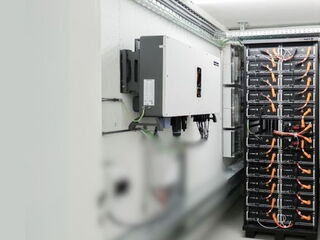
Hybrid Inverter
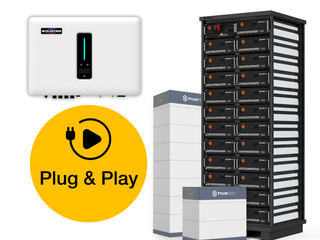
More than just converting electricity. Hybrid inverters combine PV generation, battery storage and emergency power supply in one device - ideal for optimizing self-consumption and maximum independence.
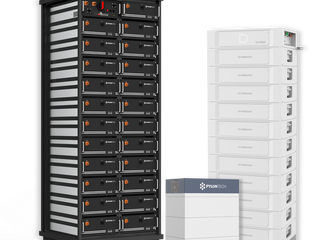
Indoor storage
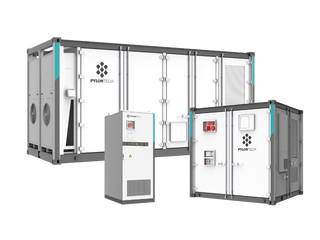
Battery storage units that impress. Available in different sizes and two different designs. From 10 kWh to 1,000 kWh.